



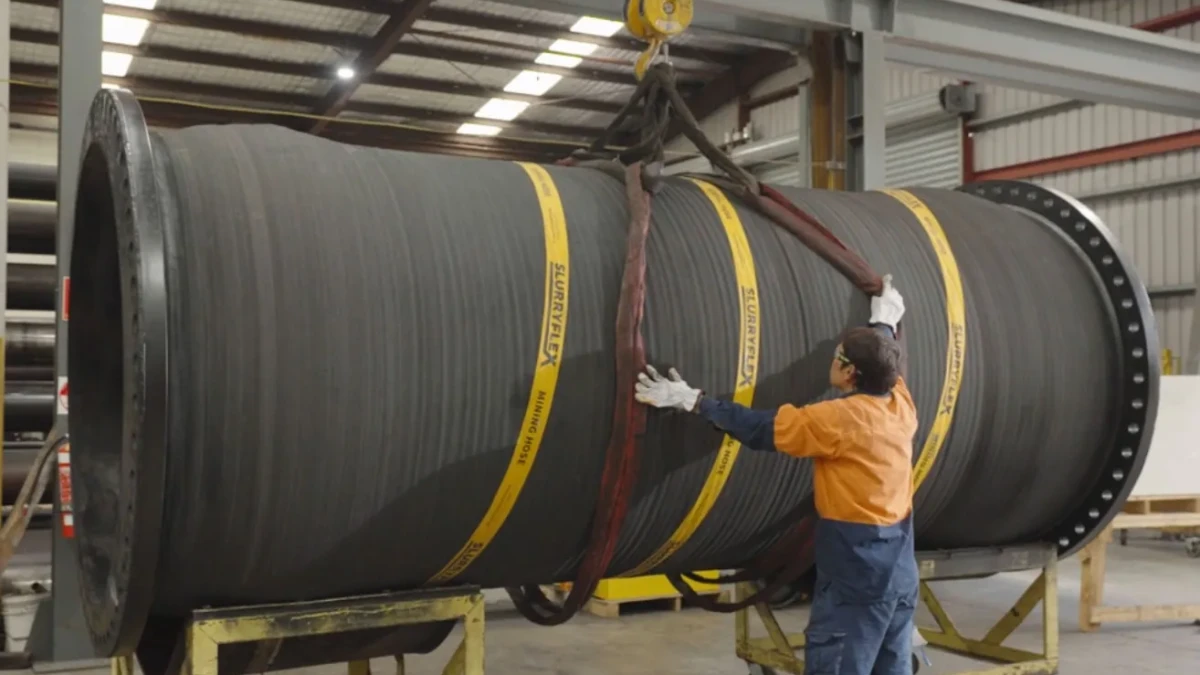
If your hoses are failing before the next shutdown, the problem is almost never the hose itself. It’s the spec.
Selecting the right mining hose for slurry service comes down to three things: the wear profile of your media, the configuration of your pipeline, and how you plan shutdowns around replacement cycles. Get those three things right and your hoses stop being a source of unplanned maintenance.
This guide covers the full range of slurry hose for mining used in mineral processing, how to match each type to your application, and what a sound approach to hose lifecycle looks like on an operating plant.
What Makes a Mining Hose Different from Standard Industrial Hose
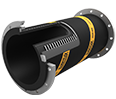
A mining hose is built from the inside out to handle wet abrasion. The inner liner is the working layer: in a rubber mining hose, this is a proprietary compound formulated specifically for resistance to abrasion, cutting, and tearing in slurry service. That compound sits behind a reinforcement layer, with a protective outer cover that handles heat, UV, and chemical exposure on the outside.
The construction matters because slurry is not a simple fluid. Iron ore tailings, cyclone feed, copper concentrate, and lithium spodumene slurry all have different particle sizes, densities, and chemical profiles. A hose that handles gold tailings well may wear quickly on a coarse iron ore discharge line running at higher velocity.
What to look for in a quality slurry hose for mining:
- Inner liner engineered for wet sliding abrasion, not general industrial duty
- Reinforcement matched to the pressure requirement: hard-wall for suction and discharge; soft-wall for discharge-only applications requiring greater flexibility
- Custom manufacture to your pipe dimensions, flange standard, and end connections
- Hot vulcanisation throughout, creating a bonded assembly rather than a glued or clamped construction
Slurryflex mining hoses are manufactured under ISO 9001 quality management, with more than 15 quality checks per hose before leaving the factory, and 100% Australian manufacturing.
Types of Mining Hose for Slurry Service
Rubber-Lined Mining Hose
The most widely used type across Australian processing plants, rubber-lined mining hose suits the full range of standard slurry duties: cyclone feed, tailings transfer, pump suction and discharge, thickener feed and underflow, and reagent lines.
The first decision is wall construction.
| Construction | Suited for | Not suited for |
|---|---|---|
| Hard-wall (SA-Series) | Suction and discharge; lines that operate under vacuum (-100 kPa) | Discharge-only locations where flexibility matters more than vacuum rating |
| Soft-wall (SB-Series) | Discharge-only service; greater flexibility for repositioning on site | Any application with vacuum or negative pressure |
Hard-wall hoses use a wire helix reinforcement that holds the bore shape under both internal pressure and vacuum. Soft-wall hoses replace the helix with a softer reinforcement layer, giving more flexibility but removing the vacuum capability. Both handle up to 5,000 kPa pressure as standard, higher on request.
All SA and SB configurations are available from DN50 to DN1500 (2–60″). Maximum hose length is approximately 15–16m (the internal length of our autoclave). For all hose diameters we recommend a maximum of 12m to optimise freight and transport: hoses can’t be coiled, so transporting longer lengths (over 12m) generally requires extendable trailers, which significantly increases freight cost.
Pre-Formed Bends, Reducers, and Fittings
Every change of direction in a pipeline is a wear point. Pre-formed bend mining hoses (SC-Series) are manufactured to the exact geometry of your system: 1D, 1.5D, 3D, 5D, or custom radius. This product replaces lined steel elbows that have traditionally been used by maintenance teams to achieve directional changes. These elbows are often subject to accelerated wear due to their rigid steel substrate and relatively thin lining thickness.
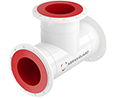
Reducers (SD-Series) and Y-pieces/laterals/tees (SE-Series) are made to order in the same way, allowing the full pipeline to be built from matched, custom-dimensioned assemblies. When every hose in a circuit shares the same dimensions, one spare fits any position in that circuit.
Superflex Mining Hose
The SF-Series Superflex is built for locations requiring maximum flexibility: pump suction connections, sections subject to significant vibration, or installations where alignment tolerances are tight and rigid pipe would cause stress cracking. It achieves greater deflection angles than a standard SA-Series while maintaining the same liner performance.
When to Specify Ceramic-Lined Hose
Rubber-lined hose handles most slurry conditions. When the wear profile of your media moves into the severe category, you need a severe wear slurry hose — one where the liner is built from ceramic rather than rubber. The Slurryflex CLX range is that product.
Signs your application needs ceramic:
- Rubber-lined hose life is measured in weeks rather than months
- High-velocity slurry with coarse or angular particles (e.g. run-of-mine iron ore)
- High solids concentration combined with elevated velocity
- Repeated liner failures at the same pipeline location despite correct rubber specification
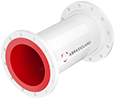
The CLX range uses fine-grain alumina ceramic tiles integrally built into the rubber using a hot vulcanisation process. This creates a seamless internal surface where the tiles cannot debond. The ceramic layer handles the wet sliding abrasion that progressively erodes a rubber liner, while the rubber substrate absorbs impact and vibration that would fracture a rigid ceramic product. Coverage is full 360° across the bore and full length as standard.
CLX configurations:
| Model | Configuration | Notes |
|---|---|---|
| XA-Series | Straight lengths, hard-wall | DN80–1500, suction and discharge, -100 kPa to +5,000 kPa |
| XC-Series | Pre-formed bends with ceramic lining | Same radius options as SC-Series |
| XD-Series | Reducers with ceramic lining | Made to order |
| XE-Series | Y-pieces and laterals with ceramic lining | Made to order |
| XH-Series | Self-floating ceramic hose | DN80–1500, for floating pipeline applications |
At FMG’s Solomon iron ore mine in WA, a cyclone overflow elbow at the base of a 20-metre drop was failing every six months in rubber-lined steel pipe. The team upgraded to ceramic-lined steel pipe, which extended life to 10–12 months, but changeouts still required a crane and crew at every shutdown. BPE recommended a Slurryflex CLX elbow with an increased bend radius, combining ceramic wear resistance with the impact absorption of a flexible rubber carcass. More than four years later, the same elbow was still in service. Eight times longer than the original rubber-lined steel pipe, and five times longer than ceramic-lined steel pipe in the same position.
For the full case study, see the FMG Solomon cyclone overflow case study.
Matching Hose Type to Your Application
Slurry hose appears across the full processing flowsheet, from primary milling through to tailings disposal. For technical resources covering mineral processing plant design and equipment selection, the Australasian Institute of Mining and Metallurgy (AusIMM) is the peak professional body for the Australian resources sector.
| Application | Typical media | Recommended type |
|---|---|---|
| Cyclone feed, standard duty | Iron ore slurry, moderate solids | SA-Series hard-wall |
| Cyclone feed, severe wear | High-velocity coarse ore slurry | CLX XA-Series ceramic |
| Tailings transfer | Dilute to moderate tailings | SA-Series or SB-Series |
| Pump suction connections | Variable slurry | SF-Series Superflex or SA-Series |
| Thickener underflow | Dense slurry, high settling solids | SA-Series or CLX XA-Series depending on duty |
| Concentrate transfer | Fine, potentially corrosive slurry | SA-Series with appropriate compound |
| Direction changes in circuit | Any slurry | SC/XC-Series pre-formed bends |
| Floating pipeline | Any slurry | XH-Series self-floating ceramic |
| High-vibration pump connections | Any slurry | SF-Series Superflex |
If your application doesn’t fit cleanly into one row, that’s a sign it warrants a proper technical review before you place the order.
Six Factors That Determine the Right Specification
1. Media Characteristics
Particle size and shape drive wear more than solids concentration alone. Angular coarse particles (run-of-mine iron ore, coarse classifier underflow) are more aggressive than fine rounded particles at the same solids content. High-velocity applications are more abrasive than low-velocity at the same particle profile. Start with the wear characterisation of your media before selecting liner material.
2. Rubber Compound Selection
Standard Grade A rubber suits most abrasive mineral processing slurries. Specific variants exist for more demanding conditions:
| Condition | Compound |
|---|---|
| Standard abrasive slurry | Grade A (standard) |
| Acidic or chemically aggressive slurry | ASR (acid-resistant) |
| Oil sands service | OSR (oil sands) |
| Elevated process temperatures | HSR (high-temperature) |
Specifying the wrong compound for the media is one of the most common causes of premature liner failure. Grade A in a low-pH acidic concentrate line will wear faster than ASR compound in the same position, not because the hose is defective, but because it was not built for those chemical conditions.
3. Pressure and Vacuum
Hard-wall hoses (SA-Series, CLX XA-Series) handle both positive pressure up to 5,000 kPa as standard and vacuum down to -100 kPa. Soft-wall hoses (SB-Series) handle positive pressure only. Confirm whether each hose position ever sees vacuum or negative pressure before selecting wall construction.
4. Configuration
Every bend, reducer, and branch connection is a wear point. Pre-formed bend hoses matched to the correct radius eliminate the mismatch between pipe geometry and hose geometry that causes kinking, localised liner wear, and premature splitting at the fitting. Order straight lengths and fittings as a matched set, built to the same dimensions, and replacement is straightforward.
5. End Connections and Flange Standards
Slurryflex hoses are available with flange drilling to match Australian and international standards: AS2129, AS4087, ASME B16.5, ASME B16.47, AWWA C207, BS EN 1092, DIN ISO 7005, JIS B2220, and others. Custom end fittings are available for non-standard connections. Confirming the flange standard and drilling at time of order avoids the installation delays that come from finding a mismatch on site.
6. Wear Monitoring
For critical hose positions, fitting a wear monitor allows condition-based replacement rather than calendar-based replacement. The Slurryflex predictive wear monitor alerts the maintenance team when a hose is approaching end of life, so the replacement is planned for the next convenient shutdown rather than triggered by a failure.
Lifecycle Considerations: Getting More From Every Hose
Standardise Dimensions Across a Circuit
Running different hose lengths in the same circuit creates unnecessary inventory complexity and slows down emergency replacements. When each hose position has a different length, the only option at 2am is to find the exact hose or build up a muff coupling. When all positions share the same dimensions, one spare handles any position in the circuit.
Standardisation also removes muff couplings from the system entirely. Muff couplings are a known leak source in service and a known injury risk during installation. Eliminating them reduces both maintenance effort and safety exposure.
Plan Replacements Around Your Shutdown Schedule
Mining hose that fails between shutdowns drives unplanned maintenance, which costs more than planned replacement in every dimension: labour, safety exposure, and lost production. The goal is to replace hoses at planned shutdowns, not in response to failures.
Condition monitoring on critical hose positions makes this achievable. If a wear monitor shows a hose has most of its liner remaining, it goes to the next shutdown. If it’s close to the end of liner life, it comes out at this shutdown rather than gambling on it holding. Turning a forced reactive event into a planned one is the whole point.
Repair vs Replace
A hose with localised surface damage to the outer cover can sometimes remain in service pending assessment. A hose with liner wear past the acceptable threshold, visible kinking, or delamination between liner and reinforcement is a replacement item. There is no reliable way to field-repair a worn inner liner on a slurry hose.
All Slurryflex hose assemblies can be hydrotested in-house to 1.5× design pressure before dispatch, with each assembly tagged for easy identification on site. If you’re building a replacement schedule around a known shutdown, hoses can be pre-built, tested, and on site ready to install before you begin.
Why Beaver Process Equipment for Mining Hose
Beaver Process Equipment operates Australia’s largest Slurryflex manufacturing facility and supplies the complete range of rubber and ceramic mining hose configurations for mineral processing. Every hose is a custom mining hose, built to order to your specific dimensions, flange standard, rubber compound, and end connection type.
Rather than catalogue supply, BPE’s technical team works through the specifics with you before the order goes to the factory: the media chemistry, particle size and solids loading, operating pressure, pipeline geometry, flange standard, and the site constraints that never appear on a datasheet. The hose that gets built is the one that matches those conditions, not the closest standard size.
Assembly, hydrotesting, and tagging all happen in-house. No assembly delays on site, no mix-ups about which hose goes where.
Project Proof Point: Rio Tinto Tom Price Iron Ore Mine
In 2018, the maintenance team at Rio Tinto’s Tom Price mine were getting 12 weeks out of standard mining hose on the cyclone feed clusters. Every replacement was a significant shutdown event. Plant performance was slipping.
BPE reviewed the system and identified three root causes: the hoses were kinking due to dimensional mismatch with the pipe geometry; hose lengths varied across the circuit so there was no common spare; and there was no visibility on wear state until a hose failed.
BPE redesigned the hose set, standardising dimensions across all cyclone feed positions, correcting the geometry to eliminate kinking, and fitting push-button wear monitors to each hose.
Shutdown intervals went from 12 weeks to 36 weeks. Three times longer between hose replacements on the same circuit.
For the full case study, see the Tom Price iron ore mine project page.
Frequently asked questions
What is the difference between hard-wall and soft-wall mining hose?
When should I use ceramic-lined hose instead of rubber-lined hose?
Ceramic-lined hose is the right choice when rubber-lined hose is wearing out faster than expected for a given application. The trigger is usually high-velocity slurry with coarse or angular particles: cyclone feed at the upper end of the velocity range, coarse underflow lines, and any application where hose life is measured in months rather than years. At FMG’s Solomon mine, a cyclone overflow elbow in rubber-lined steel pipe lasted six months. A Slurryflex CLX ceramic elbow in the same position ran for four-plus years: eight times longer than rubber-lined steel pipe, and five times longer than ceramic-lined steel pipe.
Can slurry hose be used for suction as well as discharge?
Hard-wall mining hose (SA-Series and CLX XA-Series) handles both suction and discharge service, with a vacuum rating down to -100 kPa. Soft-wall hose (SB-Series) handles discharge only. Confirm which side of the pump each hose position is on before specifying wall construction — fitting a soft-wall hose on the suction side is a common cause of hose collapse under vacuum.
What flange standards does Slurryflex hose come in?
Slurryflex mining hose is available with flange configurations to match most Australian and international standards: AS2129, AS4087, ASME B16.5, ASME B16.47, AWWA C207, BS EN 1092, DIN ISO 7005, JIS B2220, and others. Custom flange configurations are available for non-standard connections. Confirm the exact flange standard and drilling pattern for your plant at the time of ordering.
How do I choose the right rubber compound for my slurry?
The standard Grade A rubber compound suits most abrasive mineral processing slurries. Acid-resistant compound (ASR) suits low-pH or chemically aggressive streams including some gold tailings and acidic concentrate lines. High-temperature compound (HSR) applies where process fluid temperatures exceed the standard operating range. If you’re uncertain which compound applies to your media, BPE’s technical team can work through the media characteristics with you before the order is placed.
How often should slurry hose be inspected at a processing plant?
Hoses in high-solids, high-velocity slurry service should be inspected at every planned shutdown — typically every 3 to 6 months. Key inspection points are inner liner wear, kinking or deformation, outer cover condition, and end connection integrity. Hoses fitted with wear monitors can be condition-assessed between shutdowns, allowing replacement to be scheduled rather than reactive. If hoses are failing between planned shutdowns, the root cause is almost always specification rather than inspection frequency.
Talk to BPE’s Hose Specialists
If you’re specifying hose for a new circuit, replacing underperforming hose at an operating plant, or planning a pipeline rebuild for an upcoming shutdown, BPE’s team can help.
We’ll work through your application, recommend the right hose type and configuration, and handle manufacturing, hydrotesting, and delivery to site. Your hoses arrive tested, tagged, and ready to install.
Talk to our team or ask about our hose assembly and testing service.
Explore related content

4 Slurry Pump Piping Issues and How to Avoid Them
Improving reliability in your pump piping doesn’t have to be complicated. If you follow these simple steps, you won’t have to worry about your pump piping reliability again.

4 Steps to Build a Business Case to Fix Your Slurry Piping
We know that as a reliability engineer, you want to make an impact by finding smart upgrades that improve your plant. Follow these four steps, and you’ll build a persuasive business case that management can’t say no to.
Why Your Hydrocyclone Piping is Failing and How to Fix It
Improving uptime in your cyclone piping doesn’t have to be complicated. Choose the right piping and it will pay off with improved reliability and uptime.
We're here to help
Got questions? Need advice? Tap into our experience and get specialist advice from our friendly team.


Slurry piping audits
Solve slurry piping maintenance problems for good. No more leaking pipes, no more unplanned shutdowns.