



The liner is specified. The pump curve is calculated. The hydraulics check out on paper. Six months after commissioning, the wrong section is worn through, or the whole pipe bottom is gouged out when the model assumed uniform wear.
Almost always, the cause is the same: slurry characterisation was treated as somebody else's problem. Particle size, velocity, and solids concentration drive every liner selection decision in a slurry pipeline. Miss those three, and the mismatch compounds. Wrong material in the wrong zone, running at conditions the spec never anticipated.
The Three Variables That Drive Every Liner Decision
Particle Size and Shape
Particle size determines whether a slurry behaves as a homogeneous mixture or stratifies inside the pipe. Fine particles (generally below 60–100 microns) stay in suspension with the carrier fluid. They form a non-settling slurry. Coarser particles settle when velocity drops below the critical deposition velocity, producing a sliding or static bed against the pipe wall.
The wear implication differs completely for each. In a non-settling slurry, wear is distributed fairly evenly around the circumference. You get uniform liner erosion that's predictable and easier to plan for. In a settling slurry, wear concentrates toward the bottom of the pipe where the moving bed drags across the liner. That section wears faster than the top, and the liner fails unevenly, often much sooner than a uniform wear calculation would suggest.
Dr Lachlan Graham, a research engineer in fluid dynamics at CSIRO, explains the effect: "If the particle concentration is the same at the top as at the bottom of the pipe, you tend to get reasonably even wear all around the pipe. If you drop the velocity a little bit, you'll start to see stratification. In that situation, you tend to get wear towards the bottom of the pipe."
Particle shape matters as much as size. Angular particles cut into the liner surface with sharp edges. Rounded particles of the same size at the same velocity do significantly less damage. Iron ore concentrate, coarse classifier discharge, lithium spodumene: all carry angular particles. Fine copper tailings or gold leach residue at similar concentrations will produce much lower wear rates.
Slurry Velocity
Velocity has an outsized effect on wear rate in slurry pipeline design. The relationship is non-linear: wear escalates roughly with the cube of velocity at the high end. A liner that handles 2 m/s comfortably can fail rapidly at 4 m/s in the same application.
Two velocity thresholds matter in slurry pipeline design.
Critical deposition velocity (Vc): The minimum velocity at which particles stay in suspension. Below Vc, particles settle and form a moving or static bed, creating localised wear patterns and eventually blockage risk. For coarse particles in a typical 300mm mining pipeline, Vc sits between 1.5 and 3 m/s depending on particle size, density, and concentration.
High-velocity threshold (above 3–4 m/s): Above this range, wear escalates fast and liner selection becomes critical. A standard liner that performs well at 2 m/s may not survive 12 months at 4 m/s in severe slurry service.
Design velocity should sit above Vc to prevent settling, but as far below the high-velocity threshold as the hydraulics allow. Where pump pressure or gravity forces high velocity in specific sections of the pipeline, those zones need a liner upgrade, not the same spec as the rest of the line.
Solids Concentration
Higher solids content increases particle-to-liner contacts per unit volume. Wear rate goes up roughly in proportion to concentration, all else being equal. Dense slurries above 40–50% w/w in coarse-particle service are the most aggressive combination a wear liner has to handle.
Concentration also shifts pump curves and pressure requirements. A slurry that varies in concentration seasonally or with ore variability can shift wear rates significantly across the operating year. Standard practice is to design to the worst-case condition, not the average. A liner sized for average conditions will fail prematurely during peak concentration periods.
Translating Slurry Characteristics into Liner Selection
The three variables above don't drive liner selection independently. They interact. Here's how the combinations map to practical decisions.
| Slurry Condition | Wear Behaviour | Liner Recommendation |
|---|---|---|
| Fine particles (<100µm), low velocity, non-corrosive | Uniform, low wear | Unlined steel or HDPE for corrosion protection |
| Fine particles, chemically aggressive carrier | Corrosion-dominated | HDPE or polyurethane lined |
| Coarse particles (>200µm), moderate velocity | Settling, bottom wear | Rubber or polyurethane lined; rubber max 6m spools |
| Coarse angular particles, high velocity (>3 m/s) | Rapid erosive wear, impact | Polyurethane lined; ceramic hose at bends |
| Dense slurry, high concentration, moderate velocity | High wear rate, uniform | Polyurethane; thicker liner for severe duty |
| Dense slurry, coarse angular, high velocity | Maximum wear condition | Polyurethane (Abrasiguard), increased liner thickness; ceramic CLX at high-impact zones |
Two liner types from this table are frequently misapplied.
HDPE lined steel suits fine-particle, long-distance pipelines where abrasivity is low and corrosion protection is the main requirement. It's cost-effective and widely used. The risks: pull-through liner debonding under vacuum, rapid wear-through in hard rock slurry, and difficult leak detection on long runs. None of these make it suitable for coarse-particle or high-abrasivity service.
Rubber lined steel handles moderate abrasion well. It's the right choice for pump connections, short plant runs, and moderate-wear applications. The 6-metre spool length limit is a real constraint on long pipelines: three times as many spools, couplings, and joints compared to 18-metre polyurethane-lined pipe, with all the joint-count cost and failure risk that entails.
Where Failure Risk Concentrates in a Slurry Pipeline
Even with the right liner throughout, some zones wear faster than others. Knowing where failure risk concentrates lets you upgrade those sections specifically, rather than over-speccing the full line.
Pump Suction and Discharge Connections
Pipework around slurry pumps is the highest-wear zone in most processing plants. Iron ore tailings lines with four to six pumps in series drive slurry through short connecting sections at high turbulence. The combination of turbulence, velocity, and direction change attacks liners harder than any straight run.
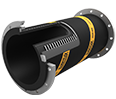
Mining hose handles this zone better than rigid spools. It fits and removes easily for pump maintenance, absorbs vibration that rigid pipe can't, and can be custom-built to match different end connections and internal diameters. For the most severe conditions (coarse particles, high velocity, high turbulence), ceramic-lined hose handles the combined impact and abrasion better than standard polyurethane.
Straight Pipeline Runs
Sliding abrasion dominates in straight runs. Wear is more predictable here: uniform around the circumference in non-settling slurry, concentrated on the bottom in settling slurry. Liner thickness selection matters most in this zone. Match the thickness to the expected wear rate and design life, and maintenance intervals become planned rather than reactive.
Velocity targeting matters too. Designing hydraulics so that straight-run velocity sits between 2 and 3 m/s for normal operating conditions keeps wear within predictable bounds and avoids the rapid escalation that appears above 4 m/s.
Bends and Direction Changes
Bends are where localised failure happens fast. Slurry particles are thrown toward the outer radius by centrifugal force. Impact concentrates on a small area rather than distributing across the full bore. That spot wears through long before the rest of the liner needs replacing.
Two design decisions reduce bend failure risk. First, avoid placing a bend close to pump discharge, where velocity and turbulence peak. Second, use long-radius bends over short-radius. Short-radius bends create a single concentrated impact point at the outside of the curve. Long-radius bends spread the impact zone across a larger area, reducing peak wear rate substantially.
On the Roy Hill Zulu 6 pipeline project, the original spec called for pre-formed short-radius bend spools. The team replaced this with a shorter upstream spool and a longer sweep of mining hose. The concentrated wear spot was removed entirely, and installation was faster than pre-formed bend spools would have been. The full approach is covered in 3 ways to reduce wear in a new slurry pipeline.
Spool Length: The Design Decision Engineers Miss
Liner material selection gets most of the attention in slurry piping specs. Spool length gets almost none. It should.
A 13km iron ore slurry pipeline built with 12-metre spools needs 1,083 spools. The same pipeline in 18-metre Abrasiguard spools needs 722. That's 361 fewer spools, fewer joints, fewer couplings, fewer crane picks, and less bolting labour. On the Rio Tinto Robe Valley Sustaining (RVS) project in WA's Pilbara, switching from 12m to 18m spools delivered a 30% reduction in spool count, 17% lower supply price, and substantially larger savings on installation.
Fewer joints matters beyond installation cost. Every coupling or weld in a slurry pipeline is a potential failure point. In abrasive slurry service, poor assembly or joint design can cause leaks well before the liner reaches end of life. Reducing joint count reduces that failure risk systematically across the full design life.
The 18-metre option isn't available across all liner systems. Rubber-lined steel is limited to 6 metres. HDPE pull-through can go longer but carries the debonding and leak detection risks already noted. Abrasiguard polyurethane-lined pipe is available to 18 metres as standard, and that's the specification choice that drives the full lifecycle cost benefit.
Abrasiguard for Severe Slurry Service
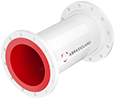
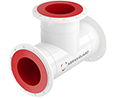
Beaver's Abrasiguard slurry piping system covers DN50–1350 in six spool configurations: straight spools (AA-Series), bends (AC-Series), reducers (AD-Series), Y-pieces (AE-Series), custom spools (AG-Series), and tees. Liner thickness is matched to the application, not a standard spec applied regardless of slurry conditions.
At Roy Hill's processing plant, a section of rubber-lined pipework in the desands circuit needed replacement ahead of a major shutdown. BPE manufactured 18 Abrasiguard spools and Slurryflex CLX hose in 14 days and air-freighted them from Brisbane, against a typical 56–60 day delivery cycle. The new installation is lasting more than 3× longer than the rubber-lined steel it replaced. Across the broader Roy Hill programme, Abrasiguard and SlurryIQ delivered 10× wear life improvement and $200k in annual maintenance savings.
Abrasiguard is manufactured in BPE's Australian facility, the same factory that produces Slurryflex hose, with a QAP programme and eight inspection checkpoints per production run. For major pipeline projects, slurry piping and hose come from one supplier, one delivery schedule, and one quality system.
Getting the Specification Right
The decisions above (slurry characterisation, liner selection by zone, spool length, flexible piping elements) are interconnected. Getting them right at the design stage is substantially cheaper than correcting them during commissioning or at the first planned shutdown.
BPE's slurry piping specification reviews work with project engineers and EPCM contractors through a structured workshop process to produce a master piping specification. The review covers material selection, internal bore matching, flexible piping elements, and piping layout, with matching standard drawings. The output is a specification you can design to with confidence, not one that creates problems after first ore.
If you're designing a new slurry pipeline or reviewing a spec for an existing operation, talk to our technical team for an application review.
Frequently asked questions
What slurry characteristics matter most for liner selection?
How do I choose between rubber and polyurethane liner for a slurry pipeline?
Rubber liner handles moderate abrasion well and suits shorter plant runs and pump connections. Its 6-metre spool length limit makes it expensive on long pipelines once you factor in additional joints, couplings, and installation labour. Polyurethane (Abrasiguard) has better abrasion resistance, lower surface roughness, and comes in 18-metre spools. For iron ore concentrate, lithium spodumene, and high-velocity applications, polyurethane is the right starting point for the specification.
What is critical deposition velocity and why does it matter?
Critical deposition velocity (Vc) is the minimum velocity at which particles in a settling slurry stay in suspension. Below Vc, particles settle to the pipe bottom, creating localised wear and blockage risk. Vc varies with particle size, density, and concentration: typically 1.5–3 m/s for coarse particles in a standard mining pipeline. Pipeline hydraulics should be designed so operating velocity stays above Vc throughout the line, including at maximum flow turndown.
Why do slurry pipeline bends fail faster than straight runs?
In a bend, slurry particles are thrown toward the outer radius by centrifugal force. Impact concentrates on a small area rather than spreading across the full bore. Short-radius bends create a single concentrated impact point that wears through fast. Long-radius bends spread the impact zone and reduce peak wear rate. Placing a bend immediately after pump discharge, where velocity and turbulence are highest, compounds the failure risk significantly.
When should I commission a slurry piping specification review?
At the early stage of slurry pipeline design, where the cost of a correct specification is low and the cost of an incorrect one compounds across the asset life. It's also worthwhile when an operating site has recurring liner failures that point to a systematic specification problem rather than isolated wear events. BPE's review covers material selection, bore matching, flexible piping elements, and layout, and produces a master specification with standard drawings.
Explore related content

Pinch Valves for Abrasive Slurry: How They Work and When to Use Them
How pinch valves work in abrasive slurry, when to specify one, and how Defender pinch valves deliver longer service life.

Mining Hose for Slurry Applications: The Complete Selection Guide
A complete selection guide to mining hose for slurry service: types, applications, failure modes, and lifecycle planning.

Rubber Lined Pipe vs Polyurethane, Ceramic and UHMWPE: A Slurry Liner Comparison Guide
Side-by-side comparison of rubber, polyurethane, ceramic and UHMWPE liners for slurry service, with selection guidance.
We're here to help
Got questions? Need advice? Tap into our experience and get specialist advice from our friendly team.


Slurry piping audits
Solve slurry piping maintenance problems for good. No more leaking pipes, no more unplanned shutdowns.